
On this page
Yellowstone sits on top of a supervolcano, which is why half the ground steams. It was the first national park in the world, it is bigger than Rhode Island and Delaware combined, and its single greatest hazard to your holiday is not bears. It is the two hours you will spend behind a queue of cars looking at a bison.
When to go
The park is effectively three parks depending on the month. Late May and early June bring waterfalls at full volume, baby animals and open roads, with some higher passes still clearing. July and August are warm, crowded and smoky in bad fire years. September is the sweet spot: elk are bugling, crowds thin sharply after Labor Day, and the light gets long and gold. From November to April most roads close entirely and access is by snowcoach or snowmobile, which is a genuinely magical and completely different trip.
The 4-day plan
Geyser country, in from the West Entrance.
- 08:30 Fountain Paint Pot One boardwalk with all four thermal feature types: geysers, hot springs, mudpots and fumaroles.
- 10:00 Grand Prismatic Spring The Midway Geyser Basin boardwalk crosses right beside the rainbow rings.
- 11:30 Grand Prismatic Overlook Park at Fairy Falls trailhead and climb 10 minutes to the overlook. The full spring only makes sense from above.
- 13:30 Old Faithful Eruptions run about 90 minutes apart, predictions are posted in the visitor center. Walk the Upper Geyser Basin loop between shows.
- 18:00 Old Faithful Inn Dinner under the 1904 lodgepole lobby, the largest log building in the world.
The shape of the place
One figure-eight road, the Grand Loop, connects almost everything, and it is about 140 miles around. Do not try to drive it in a day. Pick a base and work one half of the eight at a time.
- Old Faithful and the geyser basins in the southwest: the highest concentration of geothermal features on Earth. Give it most of a day, and walk the Upper Geyser Basin boardwalk beyond Old Faithful itself, where the crowds thin out fast.
- Grand Prismatic Spring at Midway Geyser Basin: the postcard shot is from the Fairy Falls overlook trail, not the boardwalk. It is a short uphill walk and completely worth it.
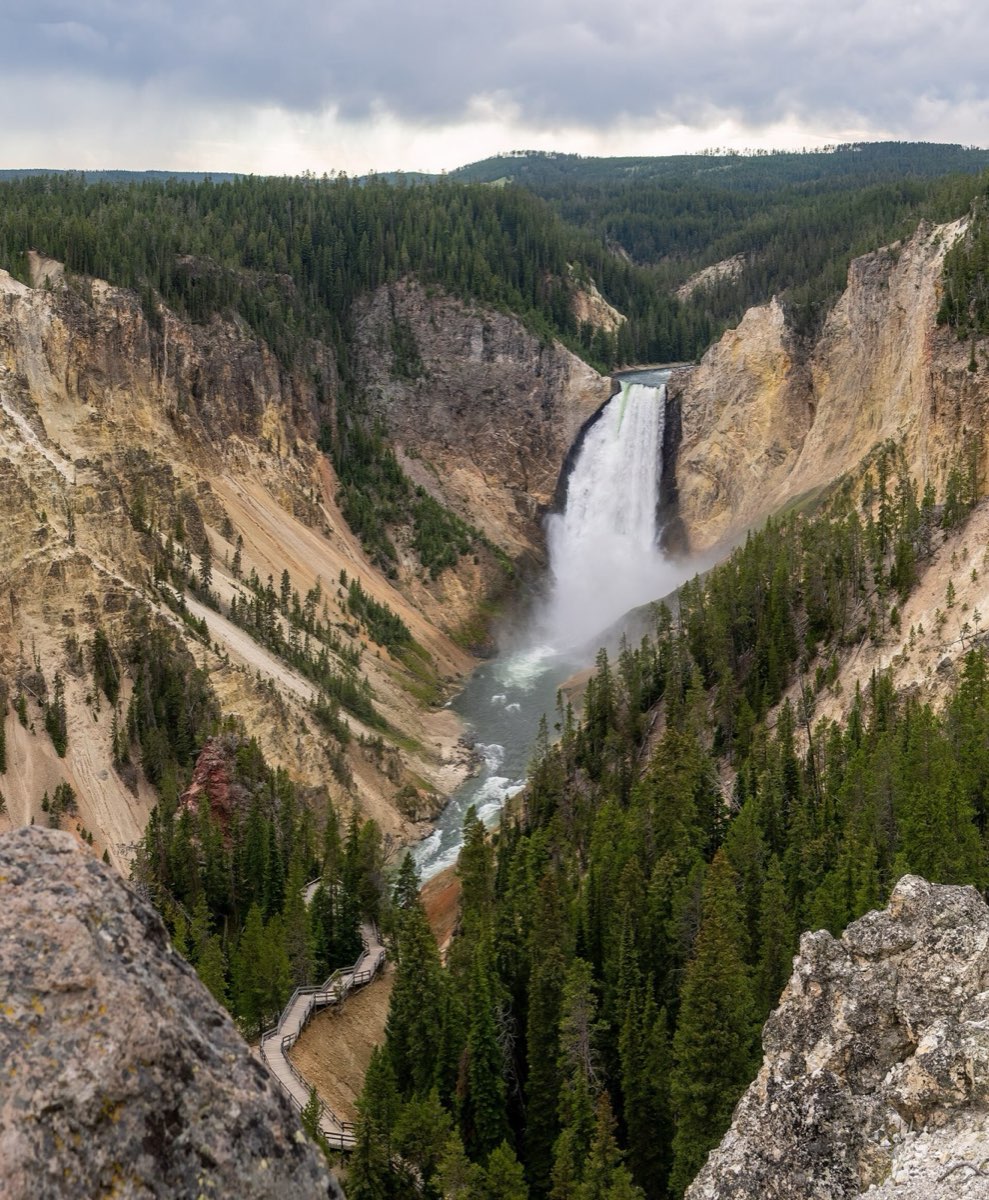
- Grand Canyon of the Yellowstone in the middle: Artist Point for the classic view, Uncle Tom's and the brink trails for the vertigo.
- Lamar Valley in the northeast: the best wildlife watching in the lower 48. Wolves, bears, bison herds. Go at dawn or dusk and bring binoculars.
- Mammoth Hot Springs in the north: terraces of white travertine, and elk that treat the village lawns as their own.
Location: Yellowstone National Park
Entrances and getting there
- West (West Yellowstone, Montana): the busiest gate, closest to the geyser basins, and the town with the most beds.
- North (Gardiner, Montana): under the Roosevelt Arch, closest to Mammoth Hot Springs, and the only entrance road open to cars all year.
- Northeast (Cooke City, Montana): straight into Lamar Valley wolf country, and the way in from the Beartooth Highway.
- East (from Cody, Wyoming): about an hour from town over Sylvan Pass to Yellowstone Lake.
- South (from Grand Teton): the Rockefeller Parkway links the two parks, so a combined trip usually enters or leaves here.
Staying over
Yellowstone has not used timed entry, but its in-park lodges and campgrounds book up further ahead than almost anywhere else in the system, often 13 months for the lodges. If you missed that window, look at West Yellowstone, Gardiner and Cooke City for beds, and accept a longer morning drive.
The safety part, briefly and seriously
- Stay on the boardwalks. The thin crust over the thermal features gives way, the water is often near boiling, and people have died doing exactly this.
- Keep 25 yards from bison and elk, and 100 yards from bears and wolves. Bison injure more visitors here than any other animal, every year.
- Carry bear spray, on your body rather than in the car, and know how to use it. See Bear country without the drama.
- Cell coverage is patchy to absent. Download your maps and tell someone your plan.
Book it and check it
- Official park page Entrance fees, opening hours, park maps and seasonal road status. https://www.nps.gov/yell/index.htm
- Current conditions and alerts Road, trail and weather status. Read this the morning you go. https://www.nps.gov/yell/planyourvisit/conditions.htm
- Recreation.gov Campsites, timed entry and permits for most federal land. https://www.recreation.gov
- Yellowstone lodges The in-park hotels and cabins, bookable about a year ahead. https://www.yellowstonenationalparklodges.com
Common questions
- Which entrance to Yellowstone is best?
- West Yellowstone for a first trip: it is closest to the geyser basins and has the most accommodation. The North entrance at Gardiner is the only one open to cars all year, and the South entrance is the natural way in if you are pairing the park with Grand Teton.
- How many days do you need in Yellowstone?
- Four full days covers the geyser basins, the canyon and one wildlife valley without rushing. Three is possible but you will be driving more than looking. Five lets you add Grand Teton to the south.
- What is the best month to visit Yellowstone?
- September, for thin crowds, active wildlife and reliable roads. Early June is the best alternative if you want waterfalls at full flow and young animals.
- Can you see Yellowstone in one day?
- You can see Old Faithful and one other basin. The Grand Loop is 140 miles of slow, wildlife-interrupted road, so a single day means picking one quarter of the park and enjoying it properly.
- Do you need bear spray in Yellowstone?
- Yes, on any trail, and carry it accessibly rather than packed. Rentals are available in the gateway towns if you have flown in and cannot bring your own.
Tip
Yellowstone and Grand Teton share a boundary and pair naturally into one trip. Put both in a single Treader plan and let the drive legs tell you how many nights each half really needs.